Resources
The Platform Work Directive and its transposition
The Platform Work Directive (Directive (EU) 2024/2831) was adopted by the European Union in 2024 to improve working conditions for people working through digital labour platforms. The Directive includes rules on employment status, algorithmic management and transparency in platform work. Member States must transpose the Directive into national law by 2 December 2026.
The European Commission has also established an expert group to support the transposition process and published a report with guidance for Member States and stakeholders.
The ETUC follows the implementation and transposition of the Directive closely and works with trade unions across Europe to support effective enforcement and the protection of workers’ rights in the platform economy. You will find updates on the transposition per country by clicking on the Platform Work Directive category.
Useful links:
• Directive text: Directive (EU) 2024/2831
• European Commission expert group report: Expert Group Report on Transposition
ETUC reports on Platform Work
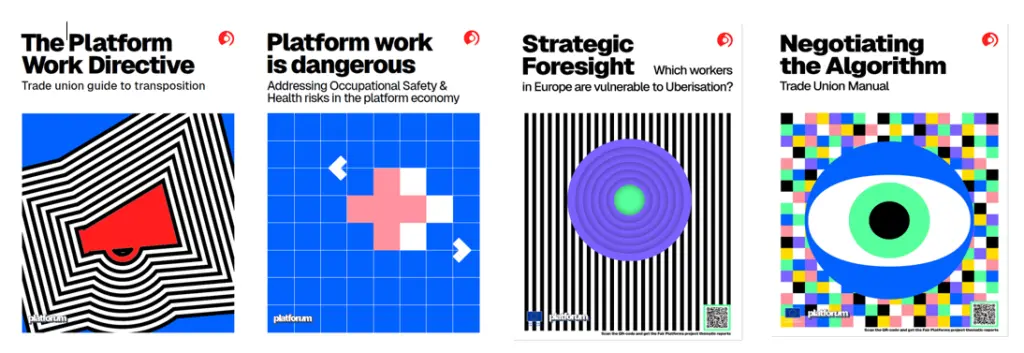
The Platform Work Directive – Trade union guide to transposition
This guide is both interpretative and practical. It brings together a clear reading of the Platform Work Directive and concrete arguments for its correct and ambitious transposition. This is not an abstract legal exercise: it is a tool for action, designed to support trade unions and their allies in a decisive phase for the future of platform workers’ rights.
Click here to read and download the report
This report is published in the framework of the ETUC Fair Platforms project, co-funded by the EU under call SOCPL-2023-INFO-WK
Platform work is dangerous – Addressing Occupational Safety & Health risks in the platform economy
As million of workers now depend on platform-mediated labour for their livelihoods, the organisation of platform work too often comes at the expense of workers’ health, safety and dignity.
This manual shows that the risks faced by platform workers are neither accidental nor unavoidable. They are the direct result of business models built on cost externalisation, algorithmic management and the systematic misclassification of workers as self-employed. Physical injuries, psychosocial stress, fatigue, exposure to violence, and the long-term health impacts of insecure and intensified work are not side effects of digitalisation; they are predictable outcomes of a regulatory vacuum that allows platforms to evade responsibility.
With the adoption of the Platform Work Directive, Member States now have a unique and time-limited opportunity to correct structural injustices in the platform economy. Against this background, this manual is a tool for unions to develop an OSH-specific strategy that will help them lead the way.
Click here to read and download the report
This report is published in the framework of the ETUC Fair Platforms project, co-funded by the EU under call SOCPL-2023-INFO-WK
Strategic Foresight – Which workers in Europe are vulnerable to Uberisation?
“Uberisation” is the spread of digital labour platforms across the economy. It presents serious risks to the quality and security of jobs in Europe, as it is associated with insecure and low-pay, limited or non-existent social protections; opaque algorithmic management practices; intensive data surveillance; and the flouting of government regulations including labour laws.
To help trade unions anticipate and respond to these developments, the report highlights the need to identify sectors that are already affected or vulnerable to uberisation, and to understand the economic, technological and political factors shaping this trend. While it’s difficult to predict companies’ future business strategies, it is possible to recognise recurring patterns in how Uberisation takes hold.
The report proposes a set of ten key indicators that characterise the platform business model and can be used to assess an industry’s susceptibility to Uberisation. These indicators form the basis for a practical tool to support trade union foresight and action.
Click here to read and download the report
This report is published in the framework of the ETUC Fair Platforms project, co-funded by the EU under call SOCPL-2023-INFO-WK
Negotiating the algorithm – Trade union manual
The proliferation of algorithmic management practices risk significant harm to workers’ rights and terms & conditions.
This trade manual explains how workers and unions can control and limit algorithmic management to ensure that company algorithms are not used to facilitate exploitation.
Click here to read and download the report
This report is published in the framework of the ETUC Fair Platforms project, co-funded by the EU under call SOCPL-2023-INFO-WK
Toolbox:
Establishing workers’ representation and social dialogue in the platform and app economy
The toolbox is the result of a two-year project involving eleven initiatives from various European countries. It incorporates the lessons learned from discussions and coaching sessions during the two years of work. The toolbox does not constitute academic research, nor does it aim to be a comprehensive catalogue of all actions undertaken in Europe since the rise of the platform company model. Rather, it aims to provide a faithful account of the messages shared by the organisations that have participated in the project over its duration. The document was written using a purely bottom-up approach. The project team took note of the messages coming from the participants and sought to organise them into a logical framework — not to give its own interpretation. While neither scientific nor exhaustive, the toolbox may be a useful instrument for addressing the challenges that unions and initiatives face in reaching out to and organising workers in platform companies, and within the framework of negotiations. Indeed, all of the strategies or combinations of strategies described in this document have proved useful at some point for at least one of the initiatives in the project.
A note on terminology before getting into the heart of the document: we refer to “platform companies” in an effort to counter the narrative put forward by these companies. While the word “platform” may evoke the idea of a digital marketplace, a simple mediator suspended in digital space, the expression “platform companies” forces us to reflect on the true nature of these companies. A digital platform company is (like an ordinary company) an employer, (temporary work) agency or intermediary. Platforms are indeed “companies” with a wide range of prerogatives and management powers. They should, therefore, assume all the obligations that come with this status, including the function of employer, where applicable.
- The first part, “Organising and building a collective”, focuses on the steps that unions and initiatives need to take in order to gain a position of strength: reaching out to workers and building membership, formulating demands, mobilising workers and communicating.
- The second part, “Strategies to open the door to negotiations”, focuses on the different approaches unions can use to pave the way for negotiations: legal or lobbying strategies, forming alliances with other relevant actors in the platform economy or coordinating at international level.